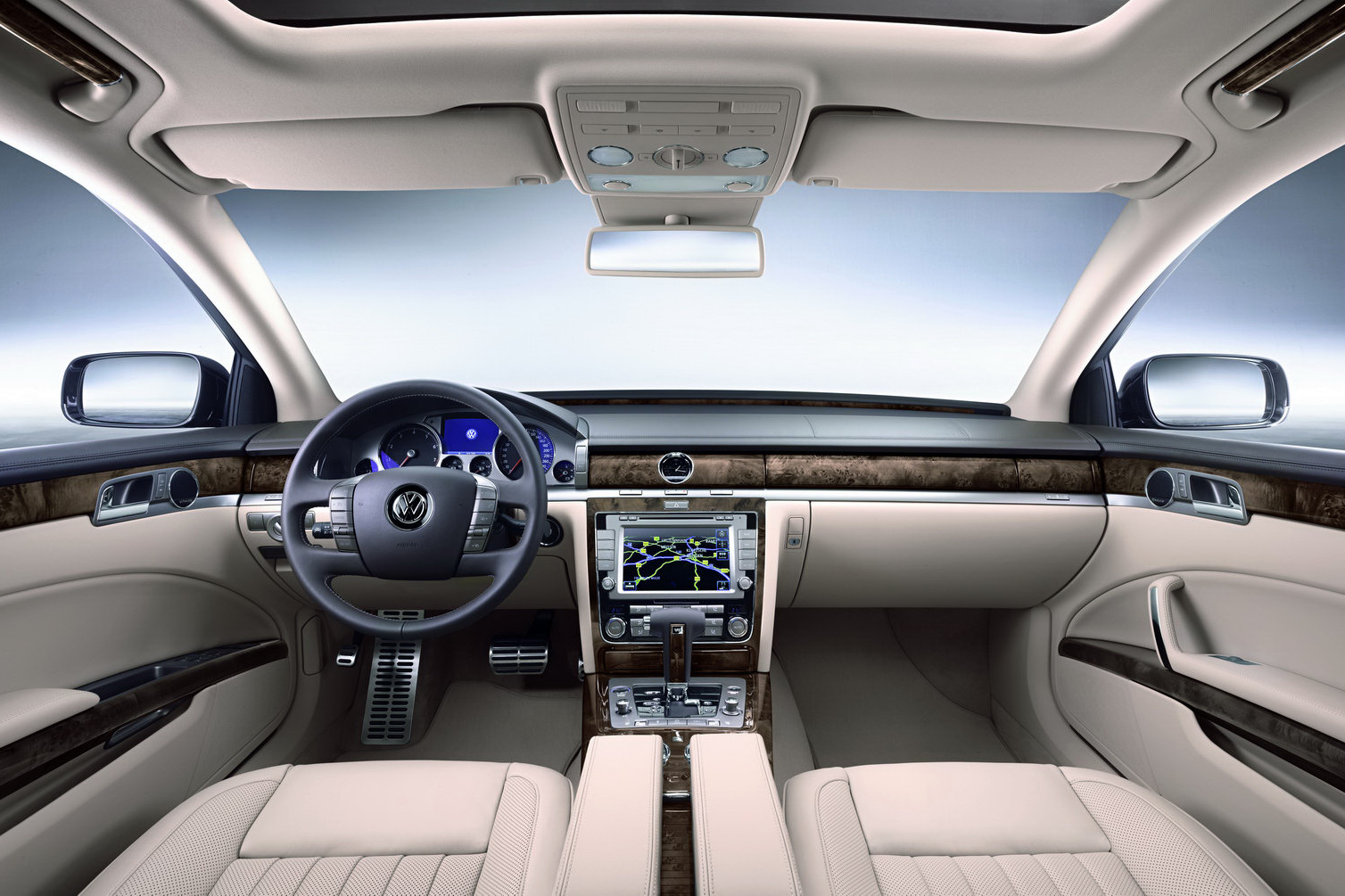
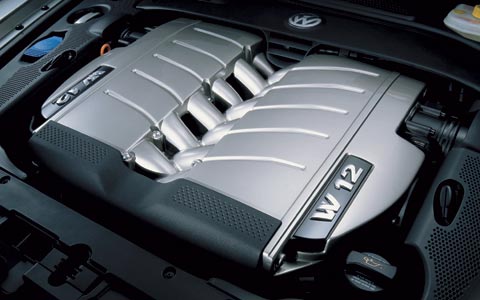
The Volkswagen Phaeton (pronounced /ˈfeɪtən/ fay-tən) is a full-size luxury sedan/saloon manufactured by German automaker Volkswagen, and is described by Volkswagen as their "premium class" vehicle. It was introduced at the 2002 Geneva Motor Show, and marketed worldwide. The name Phaeton derives from Phaëton, the son of Phoebus (or Helios) in Greek mythology, by way of the phaeton auto body style and the type of horse-drawn carriage that preceded it. The Phaeton was conceived by Ferdinand Piëch, then chairman of Volkswagen Group. Piëch wanted Volkswagen engineers to create a car that would overwhelmingly surpass the German prestige market leaders, Mercedes-Benz and BMW. The decision to release the Phaeton was, in part, a response to Mercedes's decision to compete directly with Volkswagen in the European marketplace with the low-cost A-Class. It was also intended to support the Volkswagen brand image, since the most expensive versions of lesser models, such as the Golf GTI, were starting to cost almost as much as equivalently-sized prestige brands. Although the Volkswagen group already has a direct competitor in the full-sized luxury segment, the Audi A8, the Phaeton is intended to be more of a limousine like the Mercedes-Benz S-Class, while the A8 and BMW 7 Series are more sport-oriented. Initial development of the Phaeton, given the internal project code VW611, began with Piëch giving his engineers a list of ten parameters the car needed to fulfill. Most of these specifications were not made known to the public, but a number of them were told to automotive reporters. One of them was that the Phaeton should be capable of being driven all day at 300 kilometres per hour (186 mph) with an exterior temperature of 50 °C (122 °F) whilst maintaining the interior temperature at 22 °C (72 °F). Piëch requested this even though the Phaeton's top speed was electronically limited to 250 kilometres per hour (155.3 mph). Another requirement was that the car should possess torsional rigidity of 37,000 N·m/degree. The Phaeton's platform, the Volkswagen Group D1 platform, is shared with the Bentley Continental GT and Bentley Continental Flying Spur. Certain systems, such as the automatic transmission and some engines, are also shared with the Audi A8. The D1 is a stand-alone steel platform, and was specifically developed for the Phaeton and Bentley Continental. It is commonly confused with Audi's D3 platform, which is an all-aluminium-based, instead of the D1's steel platform. As of 2011, the Phaeton has the longest wheelbase in the Volkswagen Passenger Car line. The Phaeton is hand-assembled in an eco-friendly factory with a glass exterior, the Transparent Factory (German: Gläserne Manufaktur) in Dresden, Germany. This factory also assembled Bentley Continental Flying Spur vehicles destined for the European market until October 2006, when all assembly of the Bentley products was transferred to Crewe, England. The Phaeton body is fabricated and painted at the large Volkswagen works at Zwickau, Germany, and the completed bodies are then transported about 100 km by special road transport vehicles to the Transparent Factory. Most Phaeton engines, the W12 being the notable exception, are built at the VW/Porsche/Audi engine plant in Győr, Hungary.


Development of the vehicle led to over 100 individual patents specific to the Phaeton. Distinctive features include a draftless four-zone climate system, air compressor suspension system, and standard Torsen-based 4motion four-wheel drive. With the Klavierlack (piano lacquer) option, the vehicle is double-painted and sanded between the first and second paint application. Much like the Volkswagen Passat W8, Phaeton sales fell short of expectations. It debuted at prices comparable to similar offerings from Mercedes-Benz, BMW, Lexus and, not least, the Volkswagen Group's own Audi A8 (which shared its engineering underpinnings with the Phaeton), while lacking the "brand cachet" of these competitor vehicles. In 2002, the manufacturer stated the annual capacity of the new Phaeton plant at Dresden was 20,000; by September 2006, though, a four-year total of just 25,000 had been built, with production running at approximately 6,000 cars annually. The domestic market is by far the Phaeton's strongest, with 19,314 Phaetons delivered in Germany alone by January 2009. The German luxury sedan sector continued to be dominated by the Mercedes Benz S-Class and BMW 7 series; however, both models achieved more than twice the sales volume of the Phaeton in 2008. In the United States market, 1,433 Phaetons were sold in 2004, but just 820 were sold in 2005, leading the company to announce that sales in the American market would end after the 2006 model year. The rare W12-engined models have depreciated significantly, and sell for a small fraction of their original cost. As of January 2011, Volkswagen is considering bringing the Phaeton back to the U.S. in the car's next product cycle.


As of 2007, powertrain options for the Phaeton include the following engines. 4motion permanent four-wheel drive is the only driveline system available. A front wheel drive only configuration was available with the 3.2L engine during MY 2003 and 2004 only. Vehicles manufactured for sale in the North American market were only available with the 4.2L V8 and 6.0L W12 engine, both of which were electronically limited to 210 km/h (130 mph). The Phaeton features a Bosch ESP 5.7 Electronic Stability Programme, with Anti-Lock Braking System (ABS), Electronic Brakeforce Distribution (EBD), Anti-Slip Regulation (ASR) traction control system, Electronic Differential Lock (EDL), Engine Braking Control (EBC), with emergency Brake Assist (BA). Note: The electronic differential lock (EDL) employed by Volkswagen is not, as the name suggests, a differential lock at all. Sensors monitor roadwheel speeds across an individual driven axle, and if one wheel is rotating substantially faster than the other (i.e. slipping) the EDL system momentarily brakes it. This effectively transfers power to the other wheel. For the 2009 model year, Volkswagen Passenger Cars gave the exterior and interior of the Phaeton a minor facelift to better align it with its competitors. This update included new LED daytime running lights, as well as a freshened centre console with revamped controls and materials. New Fuel Stratified Injection (FSI) V6 petrol engine with greater power and fuel efficiency (206 kW / 280 PS) which satisfy Euro-5 emissions standards is also available. Other changes to the 2009 model year car now being launched include: three new types of alloy wheels (17, 18 and 19 inch), a slightly modified radiator grille, three new exterior colours, the new leather colour, the new wood trims, white switch illumination instead of red, accent and switch trim in the new "Warm gray" colour, an upgraded car key, makeup mirror in the rear on the LWB version, dampers optimised for low-friction, Carbon fibre-reinforced Silicon Carbide (C/SiC) ceramic composite brakes (front) on the Phaeton W12, as well as a rearview camera (Rear Assist) and blind spot warning system Side Assist. For the 2011 model year the Phaeton was once again the recipient of a facelift. It was first seen at the Beijing Motor Show. The car gets a new front fascia to more closely resemble the current Volkswagen styling direction, first seen on the Golf Mk VI. (Note: the front will not be in black like the Golf, but in chrome.) This includes new LED running lights, bi-xenon headlights and a new bumper with LED fog lights. The rear LED clusters have been altered as well to mimic those found on the recently facelifted Toruan, Sharan, and new Touareg. The interior benefits from some new technologies as well, but retains the 2009 MY layout. The Phaeton will have two different versions: a normal wheelbase and long wheelbase. The Phaeton will also offer a 5-seat layout or an optional 4-seat layout. In the 5-seat version, the front seats can be adjusted 12 ways. It will have standard features like all-wheel drive, air suspension, and 4-zone automatic climate control. It will also have a multifunction steering wheel that can be ordered in leather or wood-leather.
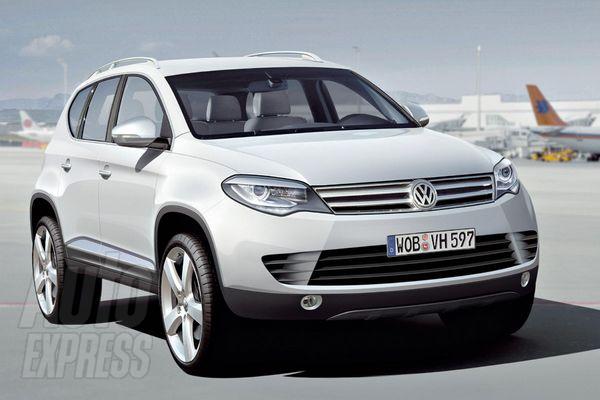
 Volkswagen Tiguan is a compact crossover vehicle (CUV) built by the German automaker Auto 5000, based on the PQ35 platform of the Volkswagen Golf. Production started in the winter of 2007 in Wolfsburg, Germany, and started selling shortly after. All Tiguans are four-cylinder powered. The Volkswagen Tiguan was announced at the 2006 Los Angeles International Auto Show held in November 2006 as a concept vehicle. The production Tiguan was released at the 2007 Frankfurt Motor Show, and debuted as a 2008 model for Europe and elsewhere and in North America as a 2009 model. Sales of the Tiguan in Canada began in April 2008. As of 2011, more than 700,000 Tiguans have been sold worldwide since September 2007. The Tiguan's largest markets (in order by sales) are Europe, Russia, the United States, China, Brazil, and Australia. The Tiguan is available in two bodystyles and three specification levels, they are: Tiguan Trend & Fun, Tiguan Sport & Style, and Tiguan Track & Field. The Trend & Fun and Sport & Style both have maximum approach angles of 18 degrees, while the Track Field has a 28-degree maximum approach angle. In The Netherlands another version is delivered namely the Comfort & Design. This is basically a Trend & Fun to which some accessories have been added. This version was created by the Dutch distributor for the Dutch market. In the UK, trim levels are S, Match, Sport and Escape. Tiguan was tested by the European New Car Assessment Programme (Euro NCAP) and received a five-star safety rating.
 The Trend & Fun specification is the entry level road oriented Tiguan. Features it includes are six airbags, ESP, Trailer Stability Program integrated with the ESP, Isofix child seat anchorages on the rear bench and electronic parking brake with auto-hold function, RCD 210 radio with integrated CD player, “Climatic” semi-automatic climate control system, four electric window lifts, electrically-adjustable and heated outside mirrors, Multifunctional Display Plus (trip computer), RF remote control of central locking and various storage compartments and bins. In addition over the Trend & Fun the Sport & Style has these features, 17-inch alloy wheels, chrome roof rail, chrome strips on front bumper and surrounding side window lining, tinted windows, sport seats with height-adjustable lumbar supports center console with folding and height-adjustable armrest, folding front passenger seat, drawers under the front seats, folding table and storage pockets on the backs of the front seats, leather for steering wheel, gear shift knob and gear shift boot, fabric seats with Alcantara accents, cruise control system and tire pressure indicator.The off-road oriented Tiguan features a redesigned front module with a 28-degree approach angle, hill descent assistant, modified driving pedal characteristic, EDS adaptation (electronic differential locks are activated at the slightest slip), ABS adaptation (which aids with braking on loose substrates), hill ascent assistance, automatic transmission gear level pre-selection (including optimal engine braking effect), 16-inch “San Diego” alloy wheels, tire pressure indicator, black roof rails, engine underbody protection, compass display and special door impact guard strips. The Tiguan Track & Field is also equipped with “Comfort seats” which feature adjustable lumbar support. This makes the vehicle particularly nimble, considering its 202" overall length.
 As part of a marketing strategy by Volkswagen the name was chosen by the public through the Auto Bild group with over 350,000 voters through Auto Bild's magazines and Web sites. The other possible names were Namib, Rockton, Liger, Samun and Nanuk. Tiguan is a combination of the German words Tiger (“tiger”) and Leguan (“iguana”). At the 2007 Michelin Challenge Bibendum in Shanghai, China, Volkswagen showed the Tiguan HY MOTION study powered by a hydrogen fuel cell. The fuel cell produces an output power of 80 kW and the electric motor has 100 kW. These figures give the Tiguan HY.MOTION a top speed of 150 km/h and an acceleration from 0 to 100 km/h in 14 seconds. The lithium-ion battery has a charge capacity of 6.8 ampere-hours and is an auxiliary energy storage system. Power output from the lithium-ion battery is 22 kW. Battery charge is recovered from braking energy or the hydrogen fuel cell. The 2010 model year was the beginning of the Tiguan R availability in the European markets. The import version of Tiguan appears on the Chinese market in 2009, but soon a locally built version (aka Shanghai-Volkswagen Tiguan) was revealed at 2009 Guangzhou Motor Show. The Chinese-built Tiguan uses 1.8TSI (118 kW) and 2.0TSI (147 kW), and has a revised front facia. At the same time the import Tiguan is still sold in China, which has 2.0TDI and R-Line kit as highlights. The basic design of the import model is the same as the international one. In order to differ locally-built and import models, Shanghai-VW Tiguan is given a Chinese name, known as 途观 (tuguan), and the import one keeps the original letter name. On July 17, 2010, the GM of Shanghai Volkswagen, plus the company's public relations chief and two other executives of the company, died in a company-owned VW Tiguan in a high-speed traffic accident. According to Chinese media reports, Shanghai VW General Manager Liu Jian and PR chief Zeng Jialin, plus two other executives, were traveling at 220 km/h (140 mph) — far exceeding the expressway maximum of 110 km/h (68 mph) — when the Tiguan hit a truck and burst into flames.