Showing posts with label Daewoo. Show all posts

Saturday, October 8, 2011

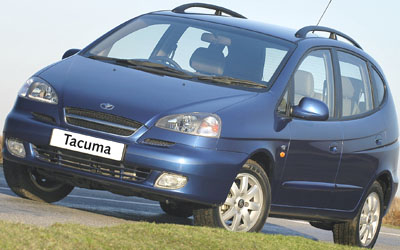
Stylish Daewoo Tacuma Cars

Elegant and stylish Daewoo Tacuma with shiny silver color and modern design


Daewoo Tacuma Car Video

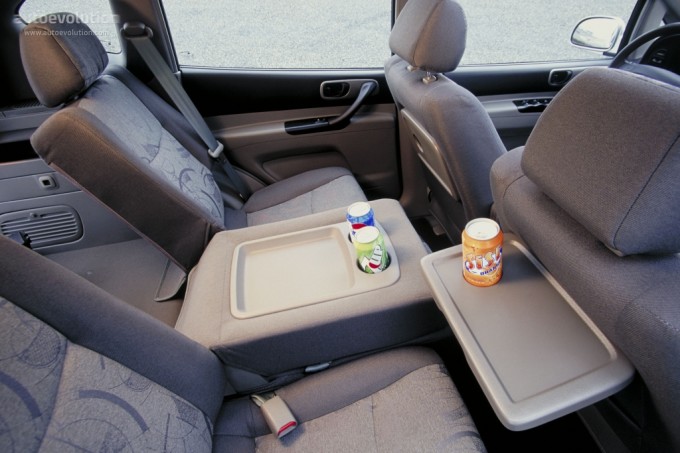
Luxury Daewoo Tacuma interior with large style

Luxury Daewoo Tacuma with shiny black color and modern design

Elegant and stylish Daewoo Tacuma with shiny red color

Sporty Daewoo Tacuma glove box with beautiful blue color

Stylish and modern Daewoo Tacuma design

Elegant Daewoo Tacuma interior design

Beautiful Daewoo Tacuma with shiny blue color

Elegant and comfortable Daewoo Tacuma interior design

Thursday, September 22, 2011

Daewoo Lacetti Compact Cars

Welcome back to my blog....
In this time we give all of you some information about compact cars and this one is Daewoo Lacetti. There are many photos of Daewoo Lacetti and information about it.


GM Daewoo Lacetti (Nubira) Commercial

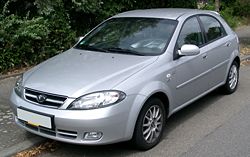
The Daewoo Lacetti is a compact car available as a four-door sedan, a five-door hatchback or a 4-door station wagon. The Lacetti is made by the South Korean firm GM Daewoo.

The sedan and wagon are designed by Pininfarina, and the hatchback by Giorgetto Giugiaro, and launched in 2002. The hatchback, known as Lacetti-5 in Korea, came later; it was introduced in summer 2003.
Visually identical models are currently also sold as Chevrolet Nubira in some European markets, Chevrolet Optra and Chevrolet Optra5 (hatchback) in Canada, Mexico, Central America, South America, India, Pakistan, Arabia, Southeast Asia, and South Africa, Suzuki Forenza and Suzuki Reno (hatchback) in the United States, Buick Excelle and Buick Excelle HRV (hatchback) in China, and Holden Viva in Australia and New Zealand. The hatchback version has recently been launched in India as Chevrolet SRV.

In South Korea, the 4-door Daewoo Lacetti was released in 2002. The 5-door hatchback showed off only after the 2004 facelift of the sedan, which mainly included a new front grill, switching from a three-part corporate Daewoo grill to a simpler, Chevrolet-style grill. The hatchback name was Lacetti5, offering a specific design for the front, rear and dashboard.

In Australia and New Zealand, the Daewoo Lacetti was briefly sold between 2003 and 2004 as a four-door sedan. During the 'Asian Economic Crisis', Daewoo became technically insolvent and the company withdrew from the Australian market.

The Lacetti was available in Canada as the Chevrolet Optra in two models, a four door hatchback (the Optra5), and an Optra Wagon, all in LS or LT trim levels (2005 Wagon only had Base or LS trim levels) . The sedan was available in 2004 and 2005, but was removed in 2006. All are powered by the 2.0 L inline-4 D-TEC engine, rated at 119 hp (89 kW) at 5400 rpmand 126 ft·lbs (171 N·m) of torque at 4000 rpm, driving the front wheels through either a 5-speed manual transmission or a 4-speed automatic. Despite its compact size and the 2.0L engine, fuel economy was poor rated at 10.7L/ 100 km for city and 7.4 for highway driving which was worse than midsize cars like the Toyota Camry or Honda Accord, considering that the Optra was a compact car.

In Mexico, the Lacetti came to the market in 2006 as Optra to replace the Chevrolet Cavalier, and it was sold only as a sedan. The Optra was phased out after the 2009 model year in favour of the Chevrolet Cruze, although for now, the Mexican Cruze is an imported model from South Korea. As the United States and Canada got the Lacetti for the 2004 model year, Mexico got the car 2 years later, making Mexico the last North American country to get the car.

In Europe, the car was initially sold as the Daewoo Nubira, with the production model being introduced at the Frankfurt Motor Show in September 2003. However, by the end of 2004, it was rebadged Chevrolet Lacetti throughout the continent. As with its home market, in some European markets, the Lacetti name is also used for the entire range of sedan, station wagon and hatchback models on the same J-series platform. In Finland and Germany, for example, only the hatchback is sold under the Lacetti name.

In 2002, The Lacetti is manufactured in India and sold as the Optra and the hatchback version is sold as the Chevrolet Optra SRV (formerly known/sold as Chevrolet SRV), which they plan to get out with a 2L diesel engine in the near future.In Pakistan , the car comes in three trim levels, 1.6L SE, 1.6L LS and 1.8L CDX. SE trim comes in manual transmission only, while LS and CDX trim come in 5 speed manual or 4 speed automatic transmission.In Japan, Suzuki briefly distributed the Lacetti as the Chevrolet Optra Wagon. It was available in two trim levels, the LS and the LT. Both came with either a 5-speed manual or 4-speed automatic transmission with a console shift. The Optra Wagon was powered by a 1.6 L or 1.8 L engine.

The Chevrolet Lacetti was picked as the new "reasonably-priced car" in Top Gear's "Star in a Reasonably-Priced Car" segment for season 8 in 2006, replacing the Suzuki Liana, which had ceased production. In this segment of the show, celebrity guests set timed laps of the Top Gear test track driving the Lacetti. In the first episode of series 15 of Top Gear, broadcast on BBC2 on 27 June 2010, the Lacetti that was used for the power laps was given a 'Viking Burial' by presenter Richard Hammond when an industrial chimney was demolished, knocking it over and burying the Lacetti in the process. Soon afterwards, the new reasonably priced car (a Kia Cee'd) was unveiled to the audience.

Monday, September 12, 2011

Daewoo Lanos

The Daewoo Lanos was a subcompact car manufactured by the Korean automaker Daewoo Motor from 1997 to 2002, and from 1997 to 2008 made under a license agreement by the Fabryka Samochodów Osobowych (FSO) in Poland, marketed as FSO Lanos, and assembled in Ukraine in modified versions known as Daewoo Sens and Chevrolet Lanos. The Chevrolet Lanos is also manufactured and sold in Egypt, from November 2008 to present (2011). For a brief period, it was also assembled by TagAZ in Russia, marketed as Doninvest Assol. The Lanos was designed by Giorgetto Giugiaro and featured three body styles - 3-door and 5-door hatchbacks and a 4-door sedan. Lanos was designed to replace Daewoo Nexia in the Daewoo lineup and was itself replaced by Daewoo Kalos. In 1992, Daewoo dissolved its joint-venture with General Motors, and simultaneously a decision was made to independently develop replacements for the contemporary Daewoo Motors products, based on older General Motors models. The Lanos development programme was formally started in autumn 1993, with the goal to create a car to replace Daewoo Nexia as Daewoo's small family car. The project began with a comparative study of competing models from 20 different manufacturers, with Toyota Tercel, Opel Astra and Volkswagen Golf identified as most competitive.

Four design studios were commissioned to deliver clay models preseting their ideas for the new model's styling. Giorgetto Giugiaro's design was chosen, and Italdesign was commissioned to develop the car's final outside and interior styling. The technical side of the project was conducted simultaneously by Daewoo's development centre Korea as well as suppliers and contractors, who were involved in developing particular components. This included AC Rochester (engine componentry), Delco Chassis Division (brakes, including ABS), GM Powertrain (automatic transmission), Italdesign (body, structural analysis, electrics, prototype construction), PARS Passive Rückhaltesysteme GmbH (airbags) and Porsche (vehicle concept — research, structural analysis, suspension and brake components, and experimental production supervision). By the end of 1995, 150 prototypes were built (providing for three body styles). The development programme involved extensive testing in a multitude of locations. Safety test included high-speed stability and durability testing in England and brake testing on the Großglockner in Austria. Low-temperature testing was conducted in Canada, Sweden (Arjeplog) and Russia (Moscow, Khabarovsk), while high-temperature tests took place in the USA (Death Valley), Oman (Nizwa), Australia (Alice Springs), Spain (Barcelona) and Italy (Nardò). The programme was completed in a remarkable time of only 30 months from the approval to the commencement of large-scale production of the Lanos sedan for the Korean market. European-market production began in 1997.


Daewoo Lanos Video

The cars were equipped with GM Family 1 D-TEC I4 engines ranging from 1.5 L (1549 cc) SOHC to 1.6 L (1598 cc) DOHC. In the UK and many countries of Europe (like Italy, France or Austria) there are also E-TEC models 1.4 (1349 cc) and 1.6 (1598 cc). The suspension is built upon that of a Daewoo Nexia, as used in Vauxhall/Opel Astra Mk2 GTE. The four models available were S, SE, SE Plus, SX, and later, the SPORT model. The S was the base model and did not include many standard features (like a CD player or power windows). The SE was just a small step up from the S base model. However, the SX model usually included a CD, radio, and cassette player along with power windows, a power side mirror, and fog lights. A few select SX models even came with a sun-roof though not many did. In the Lanos's later years, the SE and SX models were dropped and replaced with a new trim line called the SPORT (2001–2002). The SPORT included several features similar to the SX, but also included red/black leather seats, and a metallic silver dash trim. Also, the SPORT model had window controls located on the doors rather than the center console (like in the previous trim lines). From 2002, ZAZ equipped some of the kits with a domestic MeMZ-307 engine and sold this version under the Daewoo Sens name; this practice continues with the start of full-scale production of model T150.

In 2004, ZAZ adopted the Lanos chassis for full-scale production and installed new welding and painting lines. The updated version is called the ZAZ Lanos (internal model T150). The engines are still supplied by GM Daewoo, although ZAZ is currently seeking a way to acquire modern engine technology. ZAZ is selling the Lanos as ZAZ Sens. The "Sens" name is used on the pre-facelift models. Since January 2005, the Lanos produced in Poland started to be sold under the brand name of FSO. In 2005, General Motors contracted with ZAZ to provide Ukrainian-assembled Lanos models for the Ukrainian and Russian markets, to be imported duty-free, thanks to an international agreement, and sold through the GM dealer network. Sales of the Chevrolet Lanos sedan commenced in Russia in November 2005. The Chevrolet brand was utilized to compete effectively with the Renault Logan. In 2006, a panel van variant of the ZAZ Lanos was introduced. The 5-door hatchback version was available with all the options and manual transmission; it was also called Daewoo "Juliet" in Egypt. Near the end of year 2000 the Lanos was introduced with a different rear end design and a face lifted front. It was called "Lanos II" in this particular market. A SE version came with all the options plus the manual transmission. The automatic transmission version was stopped shortly after the introduction of the "Lanos II". In November 2008, GM Egypt started selling Chevrolet Lanos. The car is built in the company's factory in 6 October district and it is basically a Daewoo Lanos with a Chevrolet emblem.

Elegant Daewoo Lanos with red color

Luxury white of Daewoo Lanos

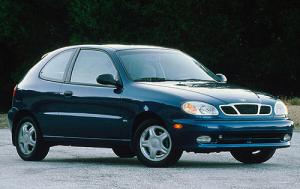
Cool Daewoo Lanos with blue color

Daewoo Lanos interior view

Cool and sporty Daewoo Lanos with blue color
Related Posts Plugin for WordPress, Blogger...